By Jan Hirabayashi

My 81-year-old mother has younger friends, a busy social life and no interest in behaving like an 81-year-old. Then I found myself doing exactly the same thing.
My mother turned eighty one this year, and to celebrate, I drove to Sarasota with my best friend of thirty years.
My friend and I are both in our sixties. We have the kind of history that makes conversation easy: old stories, private jokes and knowing when the other needs a cocktail, or a nap.
We were there to take Sally out for her 81st birthday dinner.

Sally Beckwith
Sally is healthy, active and in good shape. She is also social. When she mentioned that most of her friends were younger than she was, we were just a little surprised.
She told us about their nightly cocktail gatherings, cruise excursions and the plans they were always making. They had become a lively little community, with friendships that seemed to have very little to do with age.
As I listened to Sally describe the people who filled her days and evenings, I began to see her a little differently. My friend was getting to know Sally as a woman with a life of her own. I was seeing her, as daughters tend to do, as my mother.
As the day went on, I started noticing her world. People would pass by and call out to her.
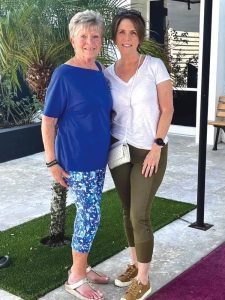
My Mom and I during a recent visit
“Whoop! Whoop!”
Sally would call back from her patio.
There was an ease to it, the familiarity of people who know you. Sally told us that if she didn’t answer with a “Whoop! Whoop!”, her friends would knock on her door to make sure she was okay.
It seemed less like younger people surrounding an older woman and more like what it really was: a community.

Celebrating good times with neighbors.
We had a wonderful day together and celebrated Sally’s birthday over dinner. Then my friend and I continued on to St. Petersburg. We had plans of our own.
When we checked into the hotel, we had lunch, a cocktail and took a brief nap. (We knew this wasn’t wasted vacation time. Given our age, it was a strategic decision.)
Later, we dressed and strolled down Beach Drive, lined with sidewalk dining and people enjoying the evening. We headed first to the Vinoy Resort for a glamorous cocktail. From there, we walked toward the St. Pete Pier, enjoying the crowds and the high-energy music coming from the top floor.
On the way back to the hotel, something shifted. The older crowd was disappearing, and the streets were filling with a younger one. There were bridal parties, couples, families and groups of friends celebrating summer.
We purposefully turned down the most crowded and energetic street, where clubs spilled music onto the sidewalks and people packed the pavement.
There were bubbles floating through the air. Music was playing, and people were dancing shoulder-to-shoulder on the sidewalk.
And somehow, we joined them.
We danced with people young enough to be our children, drank cocktails and wine, and laughed with strangers. For an hour, nobody seemed particularly interested in anyone’s age.
We were part of it.
This is worth noting because my normal bedtime is 10 p.m. Midnight is not a time I typically encounter unless I am traveling or have accidentally fallen asleep on the couch.
But there we were.
At midnight.
In St. Petersburg.
Dancing under bubbles with people decades younger than us.
And suddenly, I realized that the thing I’d noticed about my mother earlier that day was happening to me.
I was the younger friend.
Maybe my friend had helped me see my mother differently. She was looking at a woman with friends, not an eighty one-year-old woman with younger friends.
And perhaps that’s the point.
We talk about “acting your age” as though every birthday comes with a new set of rules. At forty, you’re supposed to behave differently than you did at thirty; at sixty, differently than at forty. At eighty, the rulebook presumably gets thicker.
But who wrote it?
Age changes us, of course. Our bodies change. Our responsibilities and priorities evolve. We accumulate wisdom and vision.
But the parts of us that want to laugh, make friends, travel, dance and occasionally make questionable decisions about tomorrow morning don’t necessarily disappear.
Maybe acting your age isn’t about behaving according to someone else’s expectations.
Maybe it means being fully present in the life you have.
My mother is eighty one.
My friend and I are in our sixties.
The people dancing around us were in their twenties and thirties.
For one night, the numbers didn’t matter. We were simply people having a good time.
And thinking about Sally and her younger friends, I finally understood what had been right in front of me all day.
Maybe acting your age isn’t about behaving the way people think someone your age should behave.
Maybe it’s about acting like yourself at whatever age you happen to be.
Sally is eighty one. She has younger friends, nightly cocktails, cruise excursions and people who call “Whoop! Whoop!” from the street.
I’m in my sixties. I take naps before going out, stay up until midnight when the occasion calls for it, and apparently still have enough left in me to dance under a bubble machine with people half my age.
We’re not acting younger than we are.
We’re acting our age.
And maybe that’s exactly what growing older is supposed to look like.